
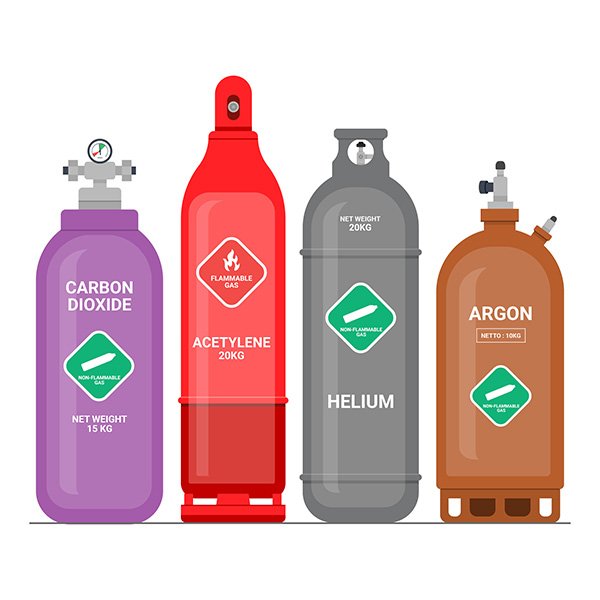
Semiconductor manufacturing is one of the most gas-intensive processes in modern industry. Every wafer that becomes a chip passes through hundreds of steps inside sealed chambers, and at almost every step a gas is doing part of the work: depositing a film, etching a pattern, purging a line, or simply keeping oxygen away from a reactive surface. Get the gas wrong, in purity or in supply, and the defect shows up on the finished device.
What gases are used in semiconductor manufacturing depends on the specific process step, but most fabs rely on a mix of high-volume bulk gases and smaller volumes of highly specialized process gases. Understanding both categories, and how they are stored and delivered, matters as much to a plant engineer as it does to whoever is designing the gas yard outside the fab.
Why Semiconductor Fabrication Depends So Heavily on Gases
A semiconductor wafer does not become a working chip through a single reaction. It goes through repeated cycles of deposition, etching, cleaning, and controlled atmosphere processing, often hundreds of times before the die is complete. Gases are the medium that makes each of these steps possible.
In a fab, gases are typically used to:
- Deposit thin films onto the wafer surface
- Etch away selected material with precision
- Purge chambers and gas lines between process steps
- Maintain an inert or controlled atmosphere
- Support oxidation and surface treatment steps
- Cool equipment and regulate chamber pressure
- Clean process chambers between production runs
Because these requirements shift constantly across a single production line, a fab’s gas system usually combines bulk industrial gases delivered in large volume with specialty gases delivered in smaller, tightly controlled quantities.
Bulk Gases Used in Semiconductor Fabrication
1. Nitrogen
Nitrogen is the workhorse gas of any semiconductor facility. It is chemically stable, widely available, and can be produced or stored in the volumes a fab needs. It is used to purge equipment and gas lines, maintain inert atmospheres around sensitive processes, and prevent unwanted oxidation on exposed surfaces.
Because nitrogen demand in a large fab can run into thousands of cubic meters a day, purity control and supply reliability are just as important as the gas itself. A dip in purity or an interruption in supply can affect an entire production line, not just one chamber.
2. Hydrogen
Hydrogen plays a role in heat treatment, surface preparation, and reduction reactions during wafer processing. It is also flammable, which means storage, distribution, and leak detection systems need to be designed with that risk in mind from the start, not added on afterward.
3. Oxygen
Oxygen is used where a controlled oxidizing environment is required, most notably in forming oxide layers on a wafer surface. It also appears in certain cleaning and plasma steps. As with nitrogen, even small amounts of contamination in the oxygen supply can affect the surface chemistry being controlled.
4. Argon
Argon is an inert gas used to create atmospheres where unwanted chemical reactions need to be avoided. It is closely associated with plasma processing, sputtering, and thin-film deposition, where it helps generate and sustain the plasma conditions used to process the wafer surface.
5. Helium
Helium’s thermal properties make it useful as a cooling gas, a heat-transfer medium, and a carrier gas in several process steps. It is also used for pressure testing. Because helium is a gas that most facilities cannot produce on site, supply and storage planning matter more here than for almost any other process gas.
Specialty Gases for Semiconductor Processes
Beyond the bulk gases, fabs rely on a smaller set of specialty gases chosen for a specific chemical role in the process.
Silane
Silane is a silicon source used in chemical vapor deposition to build silicon-containing films. It is highly reactive and requires dedicated handling infrastructure, since it can ignite on contact with air.
Ammonia
Ammonia is used in nitride deposition processes, where it supplies the nitrogen needed to form compound films on the wafer surface.
Nitrogen Trifluoride (NF₃)
NF₃ is widely used for plasma chamber cleaning. It breaks down into reactive fluorine species that remove residue built up inside process chambers between runs, keeping deposition and etch equipment consistent from wafer to wafer.
Tungsten Hexafluoride (WF₆)
WF₆ is used in tungsten deposition processes, forming metal layers that are critical to interconnects inside a finished chip.
Each of these specialty gases is supplied in small volumes but at very high purity, and the equipment used to store, regulate, and deliver them has to match that precision.
Why Cryogenic Storage and Handling Matter for Semiconductor Gases
Several of the gases used in semiconductor manufacturing, including nitrogen, oxygen, argon, and helium, are commonly stored and delivered in liquid form and vaporized on demand at the point of use. This is where cryogenic equipment becomes part of the fab’s core infrastructure rather than a supporting utility.
A few reasons cryogenic storage is the standard approach for bulk process gases:
- Liquid storage holds far more gas in the same footprint than compressed cylinders
- A well-designed cryogenic tank and vaporizer system delivers gas at a stable pressure and flow rate, which matters when a fab is running continuously
- High-purity liquid gas reduces the contamination risk that comes with frequent cylinder changeovers
- Ambient and steam vaporizers can be sized to match the exact draw of a production line, avoiding pressure drops during peak demand
At Star Cryogenics, this is the part of the gas supply chain we build for: cryogenic storage tanks, vaporizers and ambientizers, and custom-engineered cryogenic gas plants designed around the purity, pressure, and continuity requirements that semiconductor and other high-purity industries depend on. The equipment matters as much as the gas itself, because a storage and delivery system that cannot hold purity or maintain pressure will show up as a defect on the wafer, not just a maintenance ticket.
Planning a Gas Supply System for a New or Expanding Facility
For manufacturers setting up a new semiconductor line or expanding capacity, gas infrastructure is usually planned alongside the process equipment itself, not after it. Tank sizing, vaporizer capacity, purity specifications, and redundancy all need to match projected consumption and the criticality of each gas to the process.
Getting this right early avoids two common problems: undersized systems that cannot keep up with peak demand, and oversized systems that add unnecessary capital cost. Working with a cryogenic equipment partner that understands both the gas chemistry and the mechanical side of storage and delivery makes that sizing exercise far more reliable.
Final Thoughts
What gases are used in semiconductor manufacturing comes down to a mix of bulk industrial gases such as nitrogen, hydrogen, oxygen, argon, and helium, and specialty process gases such as silane, ammonia, nitrogen trifluoride, and tungsten hexafluoride. Each one plays a distinct role, and each comes with its own purity, storage, and handling requirements.
For fabs and gas suppliers alike, the equipment that stores and delivers these gases is not a secondary consideration. It is what keeps purity intact and supply continuous, which is exactly the problem cryogenic storage tanks, vaporizers, and engineered gas plants are built to solve.
FAQ
What is the most commonly used gas in semiconductor manufacturing?
Nitrogen is the most widely used gas across semiconductor fabs. It is used for purging, maintaining controlled atmospheres, and supporting a range of wafer processing steps.
Why is nitrogen stored as a liquid rather than a compressed gas?
Liquid nitrogen storage holds significantly more volume in the same footprint as compressed cylinders and, when paired with a properly sized vaporizer, delivers gas at a more stable pressure and flow rate for continuous fab operations.
Which gases require the most careful handling in a semiconductor facility?
Hydrogen and silane both require dedicated safety infrastructure because they are highly flammable. NF₃ and WF₆ also require specific handling procedures due to their reactivity.
What gases are typically supplied through cryogenic storage systems?
Nitrogen, oxygen, argon, and helium are the gases most commonly stored in liquid form and vaporized on site through cryogenic storage tanks and vaporizer systems.
Why does gas purity matter so much in semiconductor manufacturing?
Semiconductor processes are extremely sensitive to contamination. Trace moisture, particles, or unwanted chemicals in the gas supply can affect deposition, etching, and the performance of the finished device.